
IP PA Systems for Transport Hubs
How WAVMerlaud IP-networked public address technology outperforms legacy matrix systems in airports, rail terminals, and transit hubs — and why it is the architecture of choice for mission-critical environments.
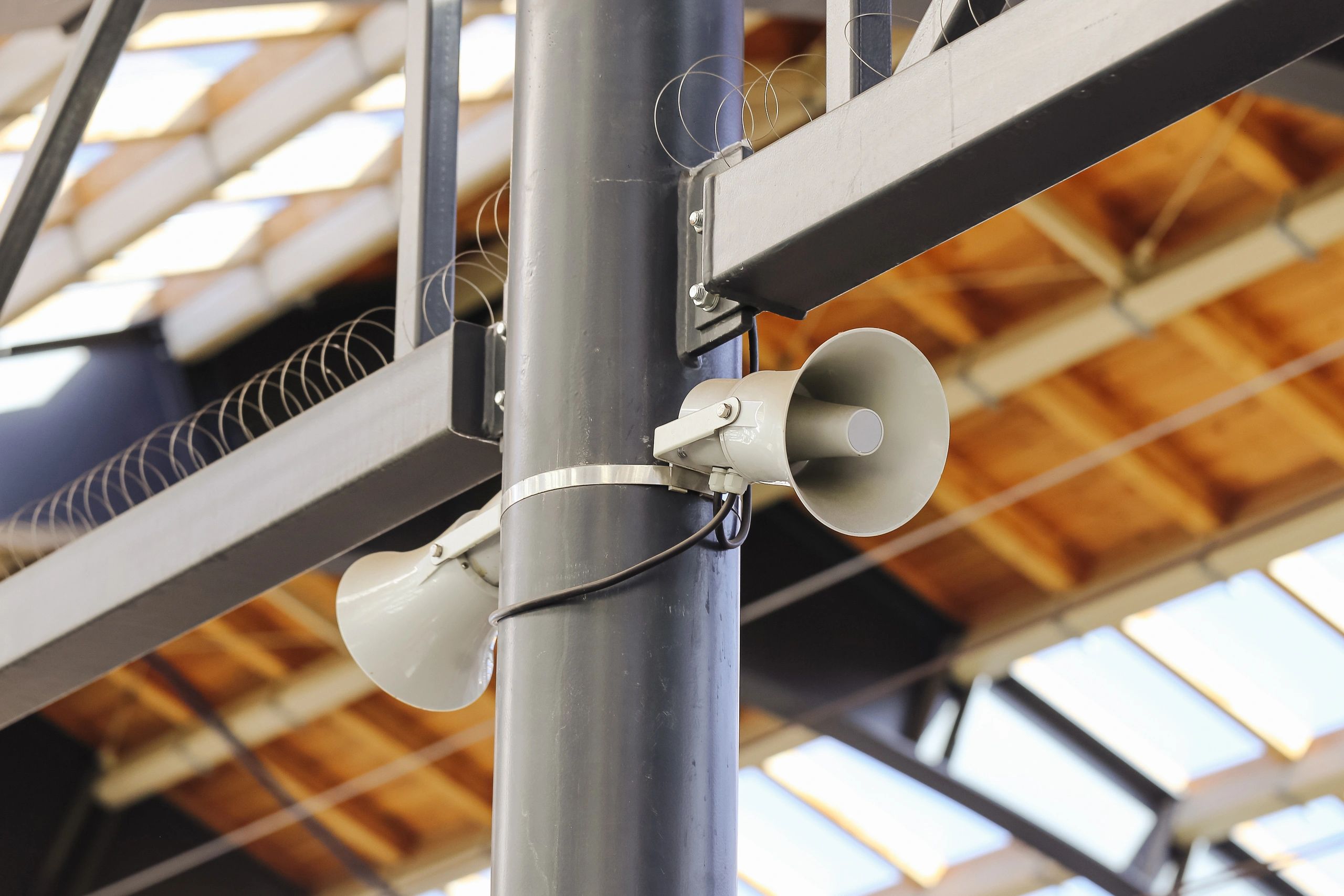
Transport hubs are among the most demanding environments for public address infrastructure. Thousands of passengers moving through concourses, platforms, and departure halls depend on clear, intelligible announcements — for wayfinding, schedule updates, and in an emergency, for their lives.
For decades, the industry relied on 100V line matrix systems: centralised amplifier racks, analogue distribution, and zone switching hardware that required specialist commissioning and was expensive to expand. That model served its purpose. But as transport hubs have grown in scale and complexity, its limitations have become impossible to ignore.
WAVMerlaud IP public address is now the architecture of choice for new-build and major refurbishment projects across airports, metro systems, mainline rail terminals, and bus interchanges. Here is why.
Where Legacy Matrix Systems Fall Short
A traditional 100V line PA system routes audio through a centralised matrix switcher. Every zone is a physical connection. Adding a zone means adding hardware. Expanding across a new terminal or a new station means running new cable infrastructure and commissioning additional matrix capacity.
In a single-building installation, this is manageable. In a transport hub with hundreds of zones spread across multiple buildings, platforms, and concourses, the complexity compounds quickly.
The core limitations are:
- Fixed zone counts. Matrix switchers have a hard channel ceiling. Scaling beyond it requires additional hardware and careful integration.
- Single point of failure. A centralised amplifier rack serving a large zone cluster creates a significant failure surface. Redundancy means duplicating expensive hardware.
- Audible latency inconsistencies. Analogue distribution introduces timing differences that become audible when adjacent zones are driven from different signal paths.
- Integration friction. Connecting a legacy PA to a modern BMS, fire panel, or passenger information system requires custom interface hardware and bespoke programming.
These limitations add cost, complexity, and ongoing maintenance burden — and they become more acute as the scale of the installation grows.
What WAVMerlaud IP Architecture Delivers
The WAVMerlaud platform replaces the analogue distribution layer with a standard Ethernet network. Audio is encoded, packetised, and delivered to IP endpoints — amplifiers, ceiling speakers, column arrays, or platform horns — using IP multicast. Each endpoint has its own network address, its own DSP, and its own local failsafe relay.
Unlimited software-defined zones
In the WAVHub platform, a zone is a logical construct defined in software — not a physical wiring configuration. Adding a zone means assigning endpoints to a new group. Removing or reconfiguring a zone is equally straightforward. A transport hub restructuring its announcement zones for a new terminal layout can do so without touching a single cable. There is no practical upper limit on zone count.
Distributed redundancy — not a single point of failure
Because each WAVMerlaud IP endpoint contains its own amplifier and DSP, the failure of any single device affects only that device's coverage area — not an entire zone cluster. Network redundancy via dual-path Ethernet and ring topologies protects against infrastructure failures. The blast radius of any single failure is dramatically smaller than in a centralised architecture.
Sub-10ms latency, deterministic and consistent
WAVHub IP multicast delivers the same audio packet to every endpoint in a zone simultaneously. With appropriate QoS configuration, end-to-end latency is sub-10 milliseconds — consistent across a zone regardless of physical distance. This eliminates the comb-filtering and echo effects that occur when adjacent analogue zones are driven from different signal paths.
Under-1-second failover
WAVMerlaud systems are engineered for under-one-second failover on amplifier or network path failure. In a life-safety environment, this is the difference between a system that maintains continuity of emergency messaging and one that does not.
Open API integration — no custom hardware interfaces
WAVHub exposes REST and WebSocket APIs. Integration with passenger information systems, fire alarm panels, building management systems, and access control is handled through software. Changes to integration logic are deployed as software updates — not hardware modifications. This eliminates the bespoke interface hardware that makes legacy PA integrations expensive and fragile.
Centralised monitoring across distributed infrastructure
A single WAVHub management instance monitors and controls PA systems across an entire transport network — multiple terminals, multiple stations, multiple buildings. Fault alerts, zone status, and announcement scheduling are visible from a single interface, reducing the operational overhead of managing distributed infrastructure.
EN54-16 and EN54-24 Compliance — Certified at the Hardware Level
For any transport hub installation that includes emergency voice alarm functionality — which in practice means almost all of them — EN 54-16 compliance is not optional. EN 54-16 sets stringent requirements for system behaviour under fault conditions, amplifier redundancy, monitoring, and fault reporting.
WAVMerlaud hardware carries independent EN 54-16 and EN 54-24 certification across its full amplifier and loudspeaker range. This is not a system-level declaration — it is component-level certification for every device in the signal chain.
What this means in practice:
Amplifier redundancy. WAVMerlaud implements N+1 amplifier redundancy at the endpoint level, with automatic failover to a backup amplifier pool. No single amplifier failure results in loss of more than the defined proportion of output capacity required by EN 54-16.
Continuous signal path monitoring. WAVHub continuously polls every endpoint, with fault conditions reported to the control panel within the time limits specified by the standard. There are no silent failures.
Fault isolation by design. Network segmentation — VLANs and separate physical infrastructure for life-safety circuits — ensures that faults in one part of the system do not propagate to others.
Specifiers should always request independent certification documentation for every hardware component. A system-level compliance claim that relies on uncertified endpoints is not EN 54-16 compliant. WAVMerlaud provides full certification documentation as standard.
Why WAVMerlaud for Transport
The combination of unlimited software-defined zones, distributed redundancy, sub-10ms latency, under-1-second failover, open API integration, and independently certified EN54 compliance is not a feature list — it is an engineering position.
Legacy PA systems were designed for a world where transport infrastructure was simpler, more static, and less integrated. WAVMerlaud was designed for the world as it is: large-scale, dynamically reconfigured, deeply integrated with digital operations systems, and subject to life-safety standards that demand verifiable, hardware-level compliance.
Transport infrastructure has a long service life. The PA system installed today needs to be supportable for 15–20 years. WAVMerlaud's software-defined architecture means that capability can be added, zones can be reconfigured, and integrations can be updated without replacing hardware — protecting the capital investment over the full lifecycle of the installation.
That is what WAVMerlaud was built to deliver.
Explore Topics
Written by
WAVMerlaud Engineering Team
The WAVMerlaud Engineering Team publishes technical guides, compliance deep-dives, and deployment insights on IP Public Address systems for mission-critical environments — transport hubs, campuses, commercial buildings, and stadia.